


Efficient management of both horizontal and vertical movement of pedestrians in commercial centers and transit facilities is what makes the buildings function properly. Architects often find themselves facing an important decision when designing such facilities regarding their construction: to build regular escalators or walking escalators. Regular escalators carry passengers up or down from one floor to another on steep inclines. On the other hand, walking escalators convey people horizontally or up gentle slopes.
 1. Understanding Escalators and Walking Escalators: How Do They Work?
1.1 Mechanical Structure of Conventional Escalators
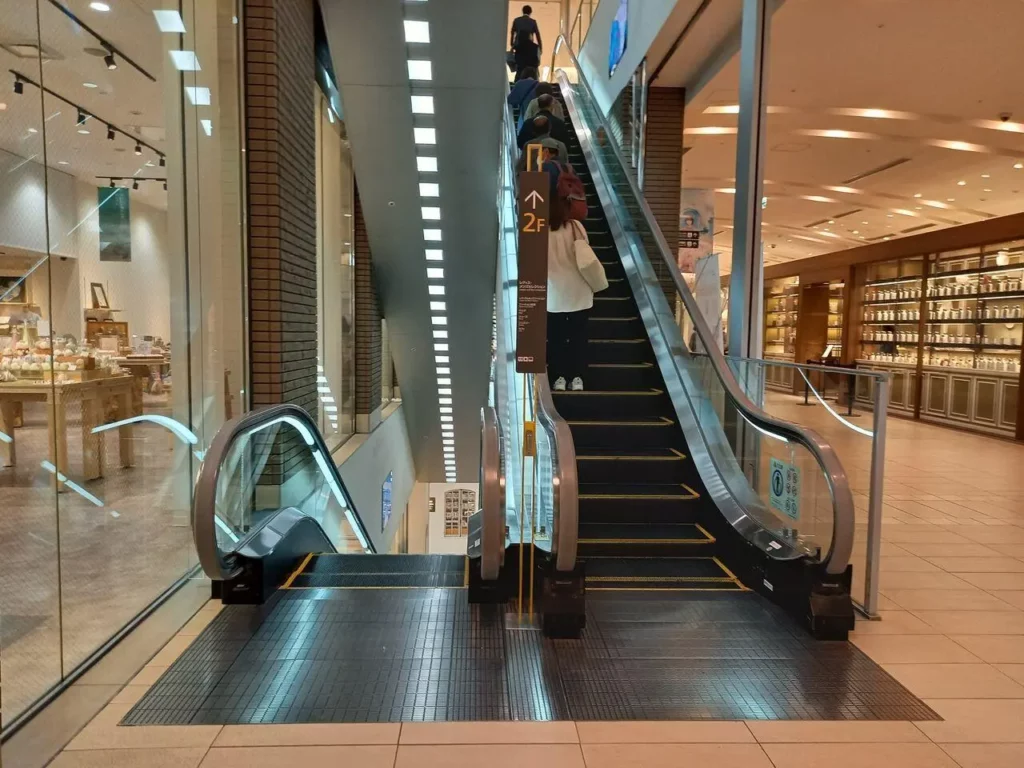
The conventional type of commercial escalator uses an interlocked mechanical design that is specially developed for vertical transportation:
- Drive System: Run by a series of interconnected step chains driven by a motor located at the top.
- Track System: Guide tracks keep each step level during movement, providing a stable walking surface for passengers ascending or descending.
- Inclination and Operating Speed: The system is typically installed at an incline of 30° or 35° and operates at a constant linear speed of 0.5–0.75 m/s.
- Main Feature: Performs excellently in transporting large crowds vertically between different floors of a building using a comparatively small horizontal space.
1.2 Engineering Mechanics of Walking Escalators
Walking escalators have an optimal flat belt conveyor designed for horizontal or mildly inclined travels:
- Conveyance Mechanism:Made up of continuously running flat pallet belt or rubber belt conveyors as opposed to individual steps.
- Incline Tolerance:Made to operate totally flat at 0° or in gently inclined areas having maximum angles of 10° to 12°.
- Power Drive and Speed: Driven by high-torque gearboxes, which keep traveling at speeds of 0.5 m/s to 0.9 m/s
- Combined Speed and Luggage Carriage: Removal of step edges allows walking while moving and increases the traveling speed, allowing ease of transporting wheeled luggage and carts.
2. Walking Escalators vs. Traditional Escalators: What’s the Difference?
Evaluating these two transit systems requires comparing key performance metrics including incline angles, passenger throughput, wheel accessibility, and power demand.
| Performance Metric | Traditional Escalators | Walking Escalators |
| Standard Incline Angle | 30° to 35° | 0° (Flat) to 12° (Inclined) |
| Rated Operating Speed | 0.5–0.65 m/s
|
0.5 – 0.9 m/s |
| Theoretical Capacity | 4,500 – 9,000 persons/hour | 6,000 – 11,400 persons/hour |
| Wheeled Equipment Support | Strictly prohibited (Safety Hazard) | Fully accessible (Carts, Luggage, Strollers) |
| Primary Transit Vector | High-density Vertical Transport | Long-distance Horizontal/Incline Transport |
2.1 Influence on Space and Inclination Restriction
The most noticeable design distinction arises from the restrictions on gradients. Escalators have a steep rise of 30° to 35°, thus saving floor space in multi-storey shopping complexes. On the contrary, the inclination walking escalators are constrained to only a 12° gradient according to global safety norms such as EN115 and ASME A17.1. This low angle needs a longer horizontal distance to cover upper floors, which makes the inclination walking escalators perfect for hypermarkets where cart access is more important than floor space.
2.2 Passenger Capacity and Dynamics of Speed
Escalators are capable of moving people strictly at pre-set machine speed. On the other hand, the combination of machine and walking speed (which is 1.2 m/s) makes horizontal walking escalators move faster, thus increasing maximum capacity to 11,400 people per hour. The latest models of walking escalators powered by a Variable Voltage Variable Frequency (VVVF) system stop when there are no people, and thereby save up to 30% of energy usage.
3. How to Choose Between Escalators and Walking Escalators
The choice of an ideal system is determined by the kind of facility, number of passengers, floor plans, and the budget required for maintenance.
3.1 Applications of the Systems in Different Facilities
- Airport Terminals & Train Stations:The length of the terminal will call for horizontal walking escalators to help passengers move through with their luggage from one gate to another and from the terminal to the exits.
- Multistory Shopping Centers: Escalators provide swift movement between levels in shopping centers without taking up any retail space.
- Supermarkets & Hypermarkets: Inclinedwalking escalators allow shoppers to transport shopping carts between floors without using elevators.
GOTS Elevator Company manufactures yürüyen merdi̇venler that will be able to handle this heavy-duty transportation. The escalators have strong stainless steel pallets, tough drive chains, and efficient power-saving modules of the VVVF kind. They cater to inclinations of 0° to 12° with widths of up to 1,400 mm.

3.2 Total Cost of Ownership and Lifecycle Maintenance
- Structural Footprint & Civil Work:Inclined walking escalators need larger opening spaces and strong beam loads for their initial installation.
- Drive System Load: Since inclined moving walkways transport passengers uphill, their drive systems must handle greater mechanical loads. In contrast, horizontal walkways may experience more wear on the pallet rollersdue to large distances.
- Safety Measures & Sensors: Both kinds of machines require comb plate switches and emergency brakes, but walking escalatorshave extra sensors to prevent pallets from getting jammed in the belt.
4. Conclusion
The choice between escalators and walking escalators depends on whether vertical transportation or horizontal movement is required. Escalators are simply the best for vertical movement; hence, they are the ideal choice for tall buildings. The walking escalators are excellent for transportation of large numbers of passengers over horizontal distances in a way that is still cart accessible. Consideration of the floor space of the building, traffic type, and energy conservation will assist you in determining the right equipment.
In case you have any queries concerning the equipment choice, technical details, or installation of escalators and walking escalators, you can always get in touch ile GOTS Asansör at all times.
SSS
How Often Should Walking Escalators Be Serviced?
Walking Escalators should be serviced in accordance with the maintenance guidelines of the manufacturer and relevant safety regulations. Periodic examination of rollers, drive chains, handrails, and sensors will help detect wear and minimize any unexpected stops.
Why Do Walking Escalators Produce Strange Noises?
The typical reasons for this can be worn rollers, looseness of parts, lack of lubrication, and improper alignment of pallets. If the Walking Escalators make strange noises, specialists should examine the machine.
Is It Possible to Customize Walking Escalators for Various Buildings?
Yes. As per the manufacturer, Walking Escalators can be configured for varying lengths, widths, installation configurations, and controls. Ensuring that the above requirements are fulfilled at the time of design will make sure that the equipment is suitable to the structural specifications.
What Safety Features Should Walking Escalators Have?
Walking Escalators can have the following safety features: Emergency Stop Buttons, Comb Plate Safety Switches, Skirt Brushes, Speed Monitoring, and Handrail Entrapment Protection. The list varies depending on the equipment design and safety regulations.
What Is the Life Expectancy of Walking Escalators?
The life expectancy of Walking Escalators varies depending on the manufacturing process, traffic volume, operating environment, and maintenance interval.